Can You Get HIV From Someone Who Is Undetectable? U=U & Viral Load Explained
The sexual HIV transmission risk is zero when a person living with HIV takes effective treatment and maintains viral suppression. Here is what U=U means, the viral-load number that matters, and what to do when suppression is uncertain.
Last updated:
No. A person living with HIV who takes effective antiretroviral treatment and maintains a viral load below 200 copies/mL has zero risk of transmitting HIV through sex. This is U=U: Undetectable = Untransmittable.
The zero-risk conclusion applies to sexual transmission, including condomless anal and vaginal sex. It does not mean HIV has left the body, that the person has been cured, or that every type of HIV test will be negative.
If the person's current viral load or treatment status is genuinely uncertain, U=U should not simply be assumed. A recent possible exposure may require prompt advice about PEP and a test plan based on the type of exposure and test.
Can you get HIV from someone who is undetectable?
No, not through sex when the person's viral load is maintained below 200 copies/mL on effective HIV treatment. In this situation, the scientifically supported risk of sexual HIV transmission is zero.
Put another way, the risk, chance, or transmission rate for sexual HIV transmission is zero while viral suppression is maintained. This is the evidence behind the public-health message U=U, meaning Undetectable = Untransmittable.
This applies to vaginal and anal sex, including sex without a condom and whether or not ejaculation occurs. Oral sex already has little to no HIV acquisition risk, and maintained viral suppression also prevents sexual HIV transmission.
U=U prevents sexual HIV transmission. It does not prevent gonorrhoea, chlamydia, syphilis, hepatitis, or other sexually transmitted infections, and it does not prevent pregnancy. Condoms and appropriate sexual-health screening can still serve those purposes.
What does HIV-positive but undetectable mean?
A person can be HIV-positive and undetectable at the same time. HIV-positive describes the person's HIV status, while undetectable describes how little HIV is measurable in their blood while effective treatment is working.
U=U means Undetectable = Untransmittable. A person living with HIV who takes effective antiretroviral therapy, also called ART, and maintains viral suppression does not transmit HIV to sexual partners.
ART stops HIV from reproducing effectively. This lowers the amount of virus in the blood, protects the immune system, and allows people with HIV to live long, healthy lives.
Treatment does not remove every copy of HIV from the body, so medication must be continued as prescribed. Undetectable is therefore a treatment and laboratory status, not another way of saying HIV-negative.
What evidence shows that undetectable HIV is untransmittable?
Large studies followed couples in which one partner had HIV and the other did not. They included heterosexual and gay couples having condomless vaginal or anal sex. When the partner living with HIV was taking ART and remained virally suppressed, researchers found zero genetically linked sexual transmissions.
PARTNER and PARTNER2
These European studies recorded many tens of thousands of acts of condomless sex and found no linked transmissions from a virally suppressed partner. PARTNER2 supplied especially strong evidence for gay male couples and anal sex.
HPTN 052 and Opposites Attract
These studies added evidence across different populations and relationship types. Together with PARTNER, their findings support the global U=U conclusion used by major public-health and HIV organisations.
For clinical wording and the below-200 threshold, see the NIH antiretroviral treatment-as-prevention guidance . A UK-focused explanation is available from the Terrence Higgins Trust .
How does someone become undetectable, and how long does it take?
A person becomes undetectable by taking an effective ART regimen as prescribed. Viral load is checked with blood tests after treatment begins and during ongoing HIV care.
Many people reach an undetectable viral load within several months. US clinical guidance says reduction below the assay's detection limit usually occurs within approximately 12 to 24 weeks after effective ART begins, although the timing varies. A person should not assume U=U applies merely because treatment has started; suppression should be confirmed by their HIV care team.
Can viral load become detectable again?
Yes. Viral load can rebound if treatment is interrupted, doses are repeatedly missed, drug resistance develops, or a regimen stops working effectively. Continued medication and viral-load monitoring are therefore essential.
What is a viral blip?
A viral blip is a temporary low detectable result after previous suppression, followed by a return to suppression. A single result does not always mean treatment failure, but an HIV clinician should interpret it. If a result is 200 copies/mL or higher, current clinical guidance recommends another prevention method until resuppression below 200 is confirmed.
U=U explained visually
HIV treatment lowers viral load. Once viral suppression is confirmed and maintained, sexual transmission does not occur.
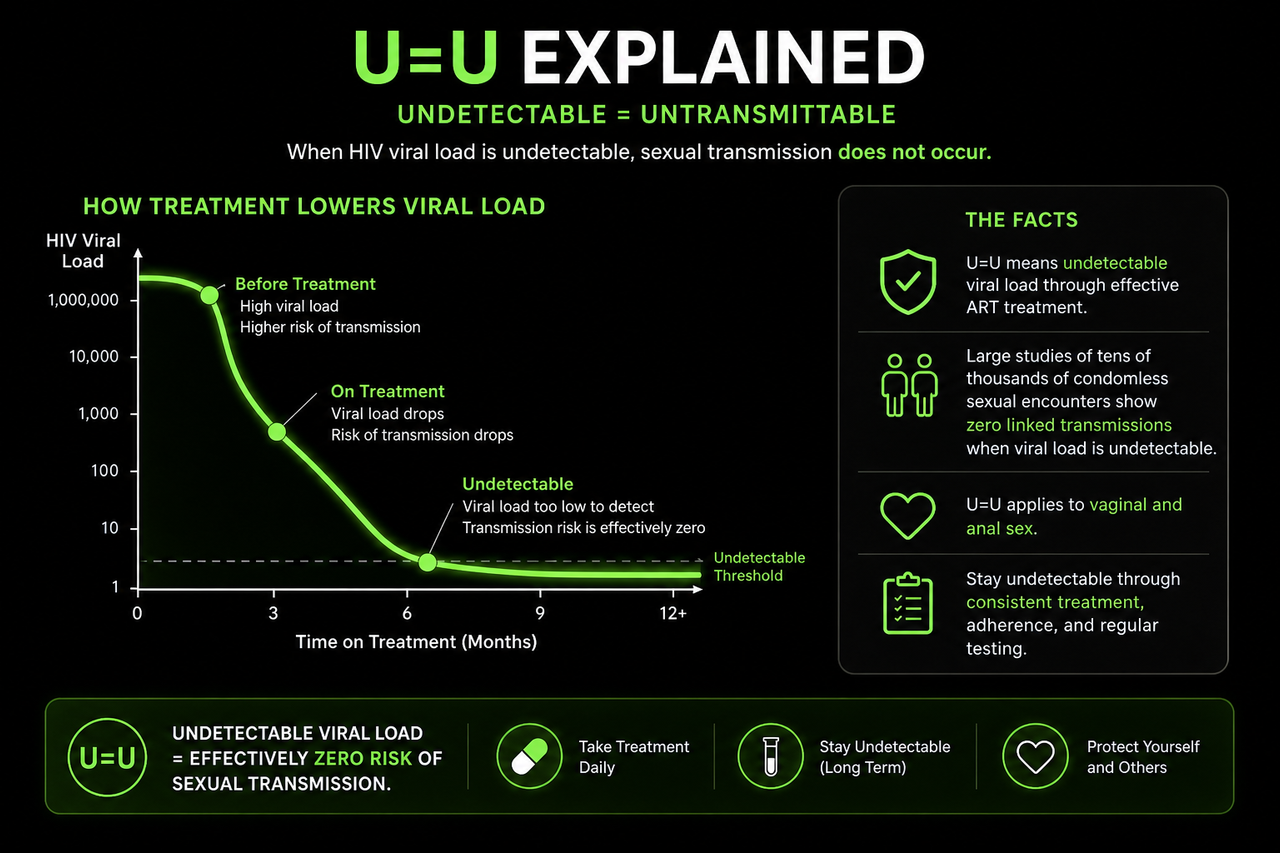
The laboratory detection limit can vary, while the clinical threshold used for U=U is a maintained viral load below 200 copies/mL.
Effective HIV treatment
Antiretroviral therapy, or ART, stops HIV from reproducing effectively.
Viral load falls
Blood tests measure how much HIV RNA is present and show whether treatment is successfully suppressing the virus.
Below 200 copies/mL
When viral load is maintained below 200 copies/mL on treatment, the person is considered virally suppressed for U=U.
Laboratory detection limits can vary. The clinical threshold used for U=U is maintained viral suppression below 200 copies/mL.
Does U=U apply to blood, shared needles, pregnancy, or breastfeeding?
The zero-risk U=U evidence is specifically about sexual transmission. Viral suppression greatly reduces HIV transmission in other settings, but the same zero-risk statement should not automatically be applied to every route.
| Situation | What current evidence means |
|---|---|
| Vaginal or anal sex | Zero HIV transmission risk when viral load is maintained below 200 copies/mL on ART. |
| Oral sex | Maintained suppression prevents sexual transmission; oral sex also has little to no HIV risk even without considering U=U. |
| Shared needles or injecting equipment | Do not use U=U as a guarantee for shared injection equipment. Never share needles, syringes, or other injecting equipment. |
| Pregnancy and birth | Effective treatment and specialist care can reduce transmission to the baby to very low levels, but pregnancy requires individual clinical management. |
| Breastfeeding or chestfeeding | ART and sustained suppression reduce risk substantially, but current guidance does not describe the risk as zero. Feeding decisions should be made with a specialist HIV care team. |
| Casual contact | HIV is not transmitted by touching, hugging, sharing toilets or dishes, saliva, sweat, or ordinary day-to-day contact, regardless of viral load. |
Does an undetectable viral load mean HIV-negative?
No. “Undetectable” describes a viral-load monitoring result in someone living with HIV. It does not convert an HIV-positive diagnosis into an HIV-negative diagnosis.
Diagnostic HIV tests and viral-load tests answer different questions. Antibody and antigen/antibody tests are used to help diagnose HIV, while a viral-load test measures HIV RNA and monitors treatment.
A person on successful treatment will generally continue to test HIV-positive on standard diagnostic tests even when their viral load is undetectable.
“HIV non-reactive” is wording used for a negative screening test. “Viral load not detected” is a treatment-monitoring result. They are not interchangeable.
What if a partner said they were undetectable but I am not sure?
A partner's statement that they are undetectable can be reassuring, particularly when they are taking treatment consistently and receiving regular HIV care. However, you cannot determine another person's current viral load from their appearance, symptoms, or medication alone.
If current suppression genuinely cannot be confirmed, evaluate the encounter using the details you know: the type of exposure, whether a condom was used, PrEP use, and whether PEP is still an option.
PEP is emergency medication that must be started within 72 hours of a potential exposure, and the sooner it is started the better. Contact an emergency department, sexual-health clinic, or other qualified clinician promptly. Read when PEP may be recommended .
If more than 72 hours have passed, PEP is no longer started for that exposure, but testing and clinical advice may still be appropriate. Use the HIV testing window guide or the window-period calculator to plan testing by test type and time since exposure.
Should you test after sex with an undetectable partner?
If the partner was taking effective treatment and maintaining a viral load below 200 copies/mL, they did not transmit HIV through sex. HIV screening may still be part of routine sexual healthcare, and testing for other STIs may be appropriate because U=U only concerns HIV.
If viral suppression was uncertain, follow the normal HIV testing window for the test being used. Symptoms cannot diagnose or exclude HIV, and an early negative result may need to be repeated. See the HIV test window-period guide for laboratory antigen/antibody tests, rapid tests, antibody tests, and NAT/RNA tests.
Frequently asked questions
Can you get HIV from someone who is undetectable?
Not through sex when the person is taking effective ART and maintaining a viral load below 200 copies/mL. The sexual HIV transmission risk is zero.
What is the HIV transmission rate when someone is undetectable?
The sexual HIV transmission risk is zero while a person is taking effective ART and maintaining viral suppression below 200 copies/mL. Major U=U studies found no genetically linked sexual transmissions from virally suppressed partners.
Is HIV still contagious when someone is undetectable?
HIV is more accurately described as transmissible rather than contagious. A person who maintains an undetectable viral load does not transmit HIV through sex, although they still have HIV and need to continue treatment.
Is U=U 100% safe for sexual HIV transmission?
U=U means zero risk of sexual HIV transmission while viral suppression is maintained. It does not prevent other STIs or pregnancy and should not be generalised to sharing injection equipment or breastfeeding.
What number is an undetectable HIV viral load?
The laboratory's undetectable limit often falls around 20 to 50 copies/mL and varies by assay. For U=U, the clinically important threshold is a maintained viral load below 200 copies/mL.
Does an undetectable viral load mean HIV-negative?
No. A person can be HIV-positive and have an undetectable viral load. Undetectable describes successful viral suppression on treatment, not an HIV-negative diagnosis.
Does “target not detected” mean HIV-negative?
No. On a viral-load report, it means the assay did not detect HIV RNA above its limit. It does not mean HIV has been cured or erase an existing HIV-positive diagnosis.
Can undetectable HIV become detectable?
Yes. Viral load can rebound if effective treatment is interrupted or stops working. Regular treatment and monitoring are required to maintain suppression.
Can someone transmit HIV immediately after starting treatment?
Treatment begins lowering viral load, but U=U should not be assumed until a viral-load test confirms suppression. Another prevention method is recommended until suppression below 200 copies/mL is documented.
Can symptoms show whether HIV was transmitted?
No. Symptoms are not specific enough to diagnose HIV. Exposure details and testing at the correct time are more useful than symptom checking.
Evidence and sources
This article uses clinical and public-health guidance rather than symptoms or unsupported transmission estimates.
This article is for education only and is not a diagnosis or personal medical advice. If a possible exposure occurred within the last 72 hours and viral suppression is unknown, seek urgent clinical advice about PEP. Individual viral-load results, treatment decisions, pregnancy, and infant-feeding choices should be discussed with a qualified healthcare professional.