Uncircumcised HIV Risk: Does Circumcision Reduce Transmission?
A practical guide to how circumcision changes HIV susceptibility for the insertive partner, why uncircumcised men may have higher risk, and which factors matter more than foreskin status.
🕓 Last updated: 4 May 2026
Being uncircumcised can increase HIV susceptibility for the insertive male partner, especially during vaginal sex.
Large clinical trials found that male circumcision reduced HIV acquisition risk among heterosexual men by about 50–60 percent. That does not mean circumcision gives immunity. It means uncircumcised men may have higher biological susceptibility when exposed to infectious vaginal or rectal fluids.
The effect is most relevant when the man is the insertive partner. It does not meaningfully protect someone who is the receptive partner, and it does not override bigger factors like condoms, PrEP, PEP, or whether the partner with HIV is undetectable.
If your partner with HIV is durably undetectable on treatment, sexual transmission risk is effectively zero regardless of circumcision status. For a deeper breakdown, read our guide to U=U and undetectable viral load.
This article is for people asking a very specific question: “I am uncircumcised. Did that make my HIV risk higher?” The honest answer is that circumcision can matter, but only in the right context. It is not a magic shield, and being uncircumcised does not automatically make every exposure high risk.
HIV risk depends on the whole situation: the type of sex, whether you were insertive or receptive, whether a condom was used, whether the partner has HIV, viral load, ejaculation, wounds or inflammation, PrEP, PEP, and the timing of testing. Circumcision is one layer in that stack, not the whole playbook.
How circumcision changes HIV risk
A simple visual overview of where circumcision matters most, what the evidence suggests, and why it does not replace prevention tools or correct HIV testing windows.
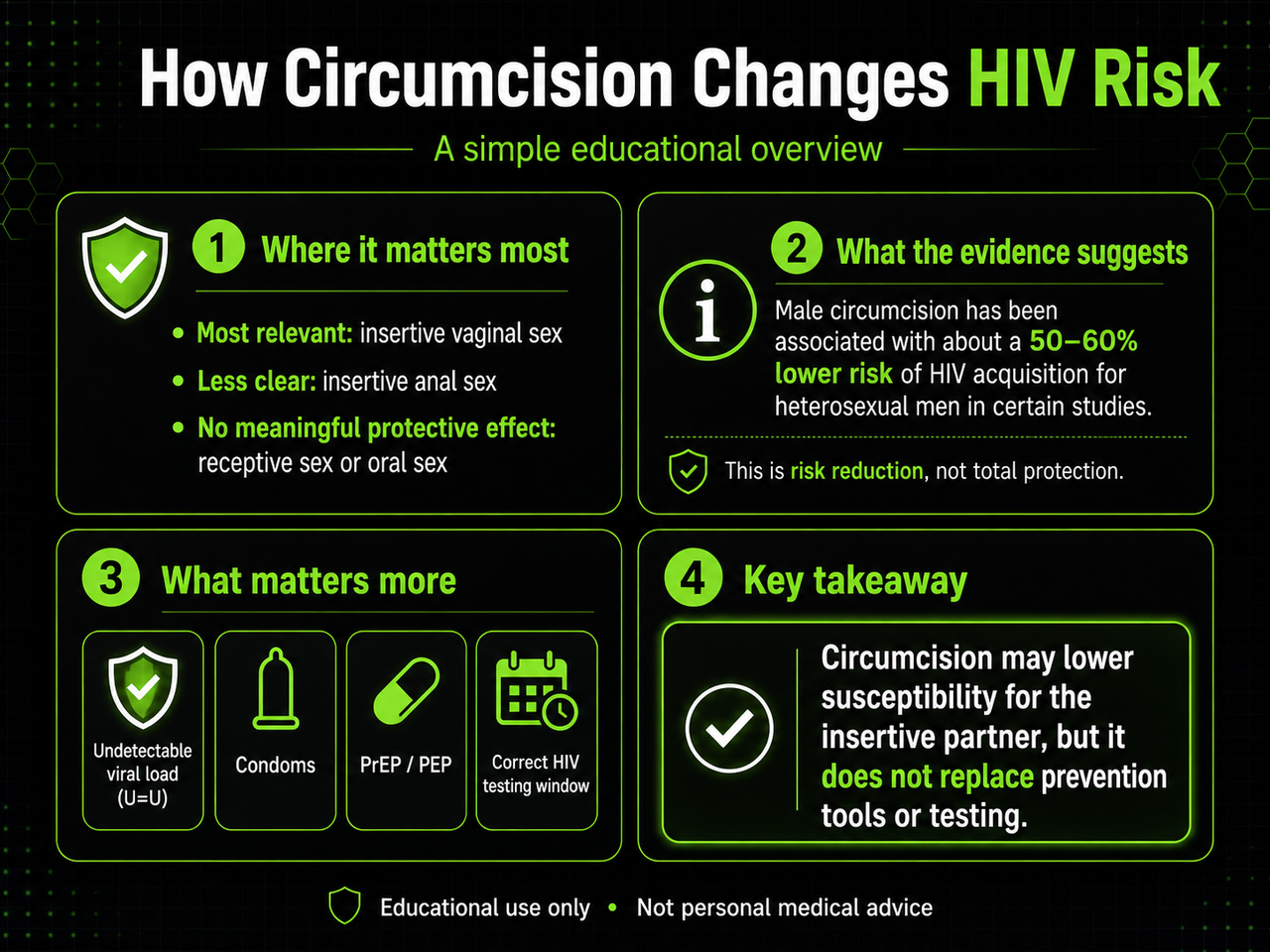
Circumcision may lower susceptibility for the insertive partner, but the bigger protection layers are still viral suppression, condoms, PrEP or PEP, and testing at the correct window.
Does being uncircumcised increase HIV risk?
Yes, for the insertive male partner, being uncircumcised can increase susceptibility compared with being circumcised. The inner foreskin contains tissue that is more vulnerable to HIV entry, and small abrasions, inflammation, or prolonged contact with infectious fluids can make exposure more biologically efficient.
This does not mean an uncircumcised man automatically has a high-risk exposure. A protected encounter with an HIV-negative partner is completely different from condomless sex with a partner who has untreated HIV. Likewise, if the partner with HIV is undetectable, the risk calculation changes dramatically.
Circumcision can lower one biological vulnerability for the insertive partner. It does not replace condoms, PrEP, PEP, viral suppression, or correct HIV testing windows.
How much does circumcision reduce HIV risk?
The commonly cited figure is about a 50–60 percent reduction in HIV acquisition risk for heterosexual men. That number comes from large randomized clinical trials, not from guessing or internet anecdotes.
But that number is a relative risk reduction, not absolute protection. If the baseline risk of a specific exposure is already low, reducing it by 50–60 percent may still leave a low absolute risk. If the baseline risk is higher, circumcision may help, but it is still not enough to replace condoms, PrEP, PEP, or viral suppression.
Circumcision ≠ immunity.
It reduces susceptibility in specific circumstances, but it does not make condomless sex risk-free and it does not cancel out untreated HIV, high viral load, or high-risk exposure types.
Think of circumcision like reducing one opening in the protection scheme. Helpful, but not a forcefield. The highest-impact protective factors are still:
- U=U: a durably undetectable viral load means no sexual HIV transmission. Read the U=U breakdown.
- Condom use: especially for vaginal and anal sex.
- PrEP or PEP: depending on whether prevention is ongoing or after a recent exposure. Read PEP vs PrEP.
- Correct testing windows: your test timing matters more than circumcision status after an exposure. Use the HIV window period calculator.
Where circumcision matters most for HIV risk
Circumcision does not affect every type of exposure equally. It mostly matters when the penis is the exposed body part and the man is the insertive partner.
| Exposure type | Does circumcision matter? | Plain-English explanation |
|---|---|---|
| Insertive vaginal sex | Most relevant | This is where the strongest evidence exists. Circumcision reduces susceptibility for the insertive male partner, but does not eliminate risk. |
| Insertive anal sex | Possibly relevant, but less clear | The insertive partner may have some biological benefit, but anal sex has different transmission dynamics and other prevention factors matter more. |
| Receptive anal sex | No meaningful protection | Circumcision status does not protect the receptive partner’s rectal tissue. |
| Receptive vaginal sex | No meaningful protection | Circumcision status affects the penis/foreskin, not the vaginal tissue receiving exposure. |
| Oral sex | No meaningful impact | Oral HIV transmission is already very low risk, and circumcision status is not the main factor. Read the oral HIV transmission guide. |
Most impact
Male insertive partner in vaginal sex.
Modest or unclear
Male insertive partner in anal sex.
No direct benefit
Receptive roles and oral sex.
Why circumcision matters biologically
HIV enters the body through vulnerable mucosal tissue. The inner foreskin contains target cells that HIV can attach to, and the foreskin can also trap fluids for longer contact during sex. Small tears, inflammation, or irritation may increase vulnerability further.
Because circumcision removes the foreskin, it reduces one route of susceptibility for the insertive partner. That is the biological reason circumcised men had lower HIV acquisition rates in major heterosexual transmission studies.
- Most relevant when the male partner is insertive.
- Less relevant or uncertain for insertive anal exposure.
- No meaningful protective effect for receptive anal or receptive vaginal sex.
- No meaningful effect for oral sex.
Circumcision and anal sex
For anal sex, the circumcision risk-reduction effect appears smaller and less certain than it is for insertive vaginal sex. The insertive partner may still have some biological reduction because the penis is exposed to rectal fluids, but anal sex has different transmission dynamics and can be more efficient for HIV transmission overall.
That means the bigger variables usually matter more: condom use, PrEP, PEP timing, viral load, ejaculation, tissue trauma, and whether the partner with HIV is on effective treatment.
Receptive anal sex remains one of the highest-efficiency sexual transmission routes, regardless of circumcision status. If you were the receptive partner, your own circumcision status is not the protective factor.
Does circumcision help the receptive partner?
No meaningful protection is expected for the receptive partner. Circumcision status affects the penis and foreskin. It does not protect the rectal or vaginal tissue receiving exposure.
For receptive vaginal or receptive anal sex, the risk profile depends much more on:
- Whether the partner has HIV.
- Whether the partner is undetectable.
- Whether a condom was used correctly.
- Whether PrEP was being taken.
- Whether PEP is still within the 72-hour window.
- The timing and type of HIV test used afterward.
Should you test differently if you are uncircumcised?
No. HIV testing windows depend on the test type and the time since exposure, not circumcision status. Being uncircumcised may affect susceptibility during certain exposures, but it does not change when RNA, p24 antigen, or antibodies become detectable.
If you are trying to work out whether your test is too early, reliable, or conclusive, use the HIV window period calculator. If you are symptom-scanning, read HIV symptoms: separating fact from fear.
Circumcision may affect exposure susceptibility. It does not change the HIV test window period.
Real-world summary
Circumcision lowers risk for the insertive male partner in certain types of sex, especially vaginal sex. But HIV transmission risk is layered. No single factor should be interpreted alone.
A circumcised person can still have risk if the exposure is high enough. An uncircumcised person can still have very low or effectively zero risk if the exposure was protected, the partner was HIV-negative, the partner was undetectable, or the encounter type was low-risk.
The cleanest way to think about it is this: circumcision modifies risk, but it does not define the whole exposure.
Frequently Asked Questions
Does being uncircumcised increase HIV risk?
For the insertive male partner, yes, being uncircumcised can increase susceptibility compared with being circumcised. The effect is most clearly shown for heterosexual vaginal exposure.
How much does circumcision reduce HIV transmission risk?
Large clinical trials found that male circumcision reduced HIV acquisition risk among heterosexual men by about 50–60 percent. This is a relative reduction, not complete protection.
Does circumcision protect during anal sex?
Circumcision may offer some biological reduction for the insertive partner, but the evidence is much stronger for heterosexual vaginal exposure. For anal sex, condoms, PrEP, PEP, and viral load matter much more.
Does circumcision help if I was the receptive partner?
No meaningful protection is expected for the receptive partner. Circumcision status affects the penis and foreskin, not the rectal or vaginal tissue receiving exposure.
Does circumcision matter if my partner is undetectable?
If a partner with HIV is durably undetectable on treatment, sexual transmission risk is effectively zero. Circumcision status does not meaningfully change that.
Should I test differently if I am uncircumcised?
No. HIV testing windows depend on the test type and time since exposure, not circumcision status.
Does circumcision matter for oral sex?
Not meaningfully. Oral HIV transmission is already very low risk, and circumcision status is not a major factor in oral exposure.
This article is for education only and is not a diagnosis or personal medical advice. If you had a recent high-risk exposure, ask a clinician about PEP as soon as possible because PEP must be started within 72 hours. For testing, use the correct window period for the test type.