Can You Get HIV From Pre-Cum? Risk, Chances and U=U
Pre-cum is not the same as semen, but it can matter if HIV is present, the partner is not virally suppressed, and the fluid reaches vulnerable tissue. This guide explains the biology without turning a low-risk detail into a panic spiral.
Can pre-cum transmit HIV?
Yes, it is biologically possible for HIV to be transmitted through pre-cum if the person producing it has transmissible HIV and the fluid reaches a mucous membrane such as the rectum, vagina, urethra, mouth with significant injury, or non-intact tissue.
In real-world risk terms, pre-cum-only exposure is generally treated as lower risk than ejaculation because the volume is usually smaller and the amount of virus is usually lower. But “lower risk” is not the same as “impossible,” especially if the HIV-positive partner is not on treatment, has a high viral load, or is in acute infection.
If the HIV-positive partner is durably undetectable on ART, sexual transmission risk is effectively zero. That point matters more than whether the fluid was pre-cum or semen.
What are the chances of getting HIV from pre-cum?
There is no clean, reliable “pre-cum-only HIV risk percentage” that applies to every situation. The chance depends on the exposure route, whether the partner has HIV, whether they are undetectable, whether there was condom use, whether ejaculation also happened, and whether there was inflammation or tissue injury.
Partner confirmed undetectable
Effectively zeroIf a partner with HIV is consistently on ART and durably undetectable, sexual transmission does not occur. In that situation, pre-cum does not create a meaningful HIV transmission concern.
No ejaculation, small exposure
Pre-cum-only exposure is usually lower than semen exposure because there is less fluid and usually less viral material. Risk still depends on whether HIV is actually present and whether the fluid reaches vulnerable tissue.
High viral load or acute infection
Risk rises if the source has untreated HIV, detectable viral load, acute HIV infection, genital inflammation, or if pre-cum is mixed with semen near ejaculation.
Not sure where your situation fits? Use the private assessment to account for partner status, exposure type, condom use, ejaculation, timing, PrEP, PEP, and testing windows.
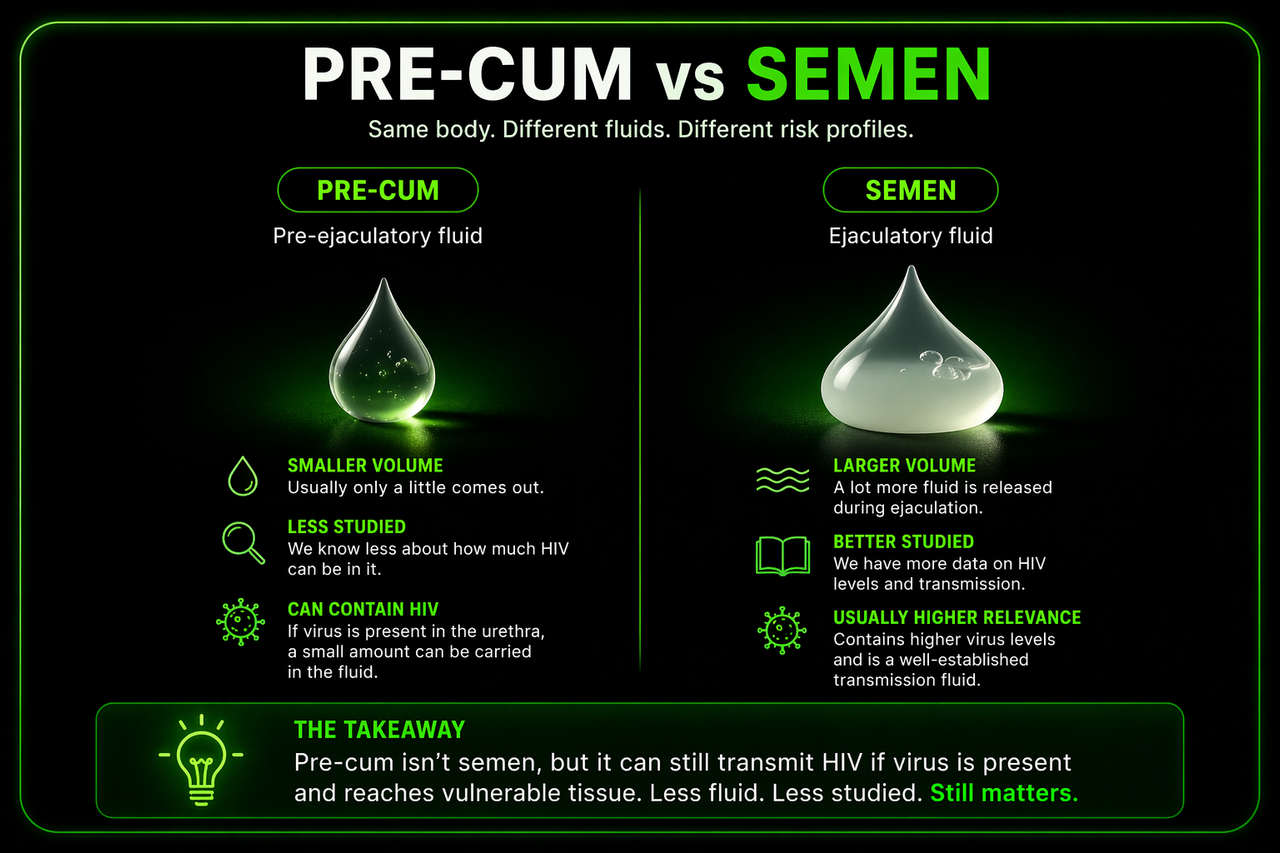
Calculate My Personal RiskPre-cum vs semen: same body, different fluids
This visual highlights the core biological distinction: pre-cum is not semen, but it can still matter if HIV is present and reaches vulnerable tissue.
What pre-cum is, and what it is not
Pre-cum, also called pre-ejaculate or pre-seminal fluid, is a lubricating fluid released from the penis during sexual arousal before ejaculation. It is produced mainly by Cowper’s glands and glands along the urethra. Its job is lubrication and conditioning the urethral environment.
Not made in the testes
Pre-cum mainly comes from urethral glands. Semen is different: it is a mixture of sperm and accessory gland secretions released during ejaculation.
Usually small
Pre-ejaculate volume varies a lot. Smaller volume usually means lower exposure than full ejaculation, but volume alone does not answer the HIV question.
It can mix with semen
Near orgasm, pre-cum may be mixed with sperm or semen-like material. That is one reason withdrawal can be messier in real life than it sounds in theory.
For HIV, sperm itself is not the main issue. The important question is whether infectious virus is present in genital fluids and whether those fluids reach tissue that HIV can use to enter the body.
How HIV could get into pre-cum
HIV transmission is not magic. It is a chain. Virus has to be present, leave the source, survive in fluid, reach vulnerable tissue, cross a barrier, and infect target immune cells. Pre-cum matters only if enough of that chain is intact.
Urethral shedding
Pre-cum passes through the urethra. If HIV is present in genital tract secretions or infected immune cells, it can theoretically be carried in the fluid.
Inflammation
Genital inflammation, urethritis, sores, or other infections can increase local immune cell activity and may increase genital shedding.
| Exposure site | Why it matters |
|---|---|
| Rectum | Rectal tissue is biologically vulnerable, has abundant target cells, and is more prone to microtrauma. This is generally the highest-risk sexual exposure site. |
| Vagina / cervix | Vaginal and cervical mucosa can be exposed to HIV-containing fluids. Risk varies with inflammation, menstrual blood, STIs, and source viral load. |
| Penile urethra | The insertive partner can be exposed through the urethral opening, foreskin, or small abrasions. Circumcision and inflammation can change risk. |
| Mouth | Oral exposure is generally much lower risk because saliva and oral tissue are less efficient routes, unless there is significant blood, injury, ulcers, or inflammation. |
| Intact skin | Intact skin is not a meaningful HIV entry route. Pre-cum on normal skin is not treated like mucosal exposure. |
Can HIV actually be found in pre-cum?
Yes, studies have detected HIV genetic material in pre-ejaculate. But the key is viral load. Pre-cum from someone with detectable HIV is not the same as pre-cum from someone who is durably undetectable on treatment.
| Group | Pre-ejaculate finding | What it means |
|---|---|---|
| Detectable blood viral load | HIV RNA detected in 1 of 8 pre-ejaculate samples | When blood viral load is detectable, genital shedding can happen, and pre-cum can contain HIV RNA. |
| Undetectable blood viral load | HIV RNA detected in 0 of 52 pre-ejaculate samples | In this study, pre-ejaculate HIV RNA was not detected when blood viral load was undetectable. |
| Important nuance | RNA detection is not identical to infectious transmission | Finding viral RNA shows biological plausibility. Real-world transmission risk is best understood through route, viral load, exposure type, and U=U outcome studies. |
This is why the answer is careful: pre-cum can carry HIV, but the practical risk depends heavily on whether the source has a transmissible viral load.
Does urinating before sex flush sperm or HIV out of pre-cum?
Urinating before sex can flush some residual material from the urethra, but it does not sterilise the urethra, stop new secretions, or remove HIV risk if the person has transmissible HIV. Pre-cum is produced during arousal after urination can already have happened.
Urinating may reduce residual sperm
The idea makes more sense for pregnancy than HIV: urinating may help flush sperm left in the urethra after a prior ejaculation. But studies still show sperm can sometimes be found in pre-ejaculate.
It does not remove transmission risk
HIV risk is not just about leftover sperm. It is about viral load, genital shedding, mucosal exposure, inflammation, and whether infectious virus reaches target tissue.
Why withdrawal does not make HIV risk disappear
Withdrawal lowers exposure by trying to avoid ejaculation inside the body. That can reduce the amount of semen exposure, but it does not guarantee a pre-cum-only event.
Timing has to be exact
Withdrawal depends on pulling out before ejaculation every time. In real life, timing mistakes, partial ejaculation, and fluid mixing can happen.
Pre-cum can still contact mucosa
Even without ejaculation, pre-cum can still contact rectal, vaginal, urethral, or oral tissue. Whether that matters depends on the source’s HIV status and viral load.
If the exposure was anal sex, tissue biology matters more than the label “pre-cum.” See the related guide on anal sex HIV risk tiers.
What should you do after possible pre-cum exposure?
Identify the route
Was the exposure anal, vaginal, oral, urethral, or only skin contact? Mucosal exposure matters more than fluid touching normal skin.
Clarify the source status
Confirmed undetectable is a major de-escalator. Unknown status, untreated HIV, or possible acute infection requires a more cautious risk review.
Check the 72-hour PEP window
If the exposure could be substantial-risk and happened within 72 hours, speak to a clinician urgently about PEP. PEP decisions are time-sensitive.
Use testing for certainty
If PEP is not indicated or the window has passed, testing is how certainty is built. A 4th-generation lab test is commonly used as a strong endpoint around 45 days.
Want a scenario-specific estimate? The report accounts for partner status, act type, condom use, ejaculation, timing, PrEP, PEP, and testing windows.
Get My Private AssessmentKeep building the full picture
Pre-cum risk is easier to understand once you separate fluid, exposure route, viral load, and testing timing.
Frequently asked questions
Yes, it is biologically possible if the source has transmissible HIV and pre-cum reaches vulnerable tissue. The risk is usually lower than ejaculation, but not automatically zero unless the source is durably undetectable.
It can. Studies have detected HIV RNA in pre-ejaculate from some men with detectable viral load. In one study, HIV RNA was not detected in pre-ejaculate from men with undetectable blood viral load.
There is no single reliable percentage for pre-cum-only exposure. The chance depends on viral load, exposure route, whether ejaculation also occurred, condom use, inflammation, PrEP, PEP timing, and whether the source is undetectable.
Usually yes. Pre-cum usually involves less fluid and often lower viral exposure than ejaculation. But if HIV is present and the exposure route is vulnerable, it can still be biologically relevant.
No. Urination can flush some residual material from the urethra, but it does not sterilise the urethra, stop new pre-cum from being produced, or remove HIV risk if the person has transmissible HIV.
Withdrawal may reduce semen exposure, but it does not eliminate pre-cum exposure and it can fail in real-world use. Condoms, PrEP, PEP when appropriate, testing, and viral suppression are more reliable risk controls.
If the partner is durably undetectable on ART, sexual HIV transmission is effectively prevented. That applies even if pre-cum or semen is present.
It depends on the route, source status, condom use, and timing. If the exposure may be substantial-risk and it happened within 72 hours, seek urgent clinical advice about PEP.
Sources and references
- CDC, Can I Get or Transmit HIV From...? hivrisk.cdc.gov
- CDC, HIV Risk and Prevention Estimates: cdc.gov/hivpartners
- HIV.gov, How Is HIV Transmitted? hiv.gov
- Politch et al., HIV-1 in pre-ejaculatory secretions: PMC article
- Killick et al., Sperm content of pre-ejaculatory fluid: PMC article
- Expert consensus statement on HIV transmission and viral load: PMC article
This article is for education, not diagnosis or personal medical advice. If you think you had a substantial-risk HIV exposure within the last 72 hours, contact a clinician, sexual health service, urgent care service, or emergency department immediately.