Can HIV Survive Outside the Body? Air, Surfaces, Water and Hot Tubs
A calm, evidence-based explanation of why HIV is not airborne, does not spread through water or casual surfaces, and when blood exposure actually matters.
🕓 Last updated: 5 May 2026
No, HIV is not airborne and does not spread through air, water, hot tubs, pools, toilets, surfaces, towels, bedding, sweat, tears, saliva, or casual contact.
HIV is a fragile, envelope-based virus outside the body. It cannot reproduce outside a human host, and once exposed to air, drying, dilution, heat, or ordinary environmental conditions, it rapidly loses the ability to infect.
Real HIV transmission requires the right fluid, enough viable virus, and a direct route into the bloodstream or vulnerable mucous membranes.
The main real-world “outside the body” exception is blood inside a needle or syringe, where blood can stay wet and protected from air. That is why needle sharing and needle-stick injuries are treated differently from touching surfaces.
If you are here because you touched something, sat somewhere, cleaned a bathroom, handled laundry, saw dried blood, used a hot tub, shared a towel, or worried about HIV “living in the air,” this page is designed to give you a clean scientific answer. HIV does not transmit through casual environmental contact.
A simple visual breakdown of the common environmental HIV fears, including air exposure, surfaces, dried blood, pools, hot tubs, toilets, towels, and casual contact.
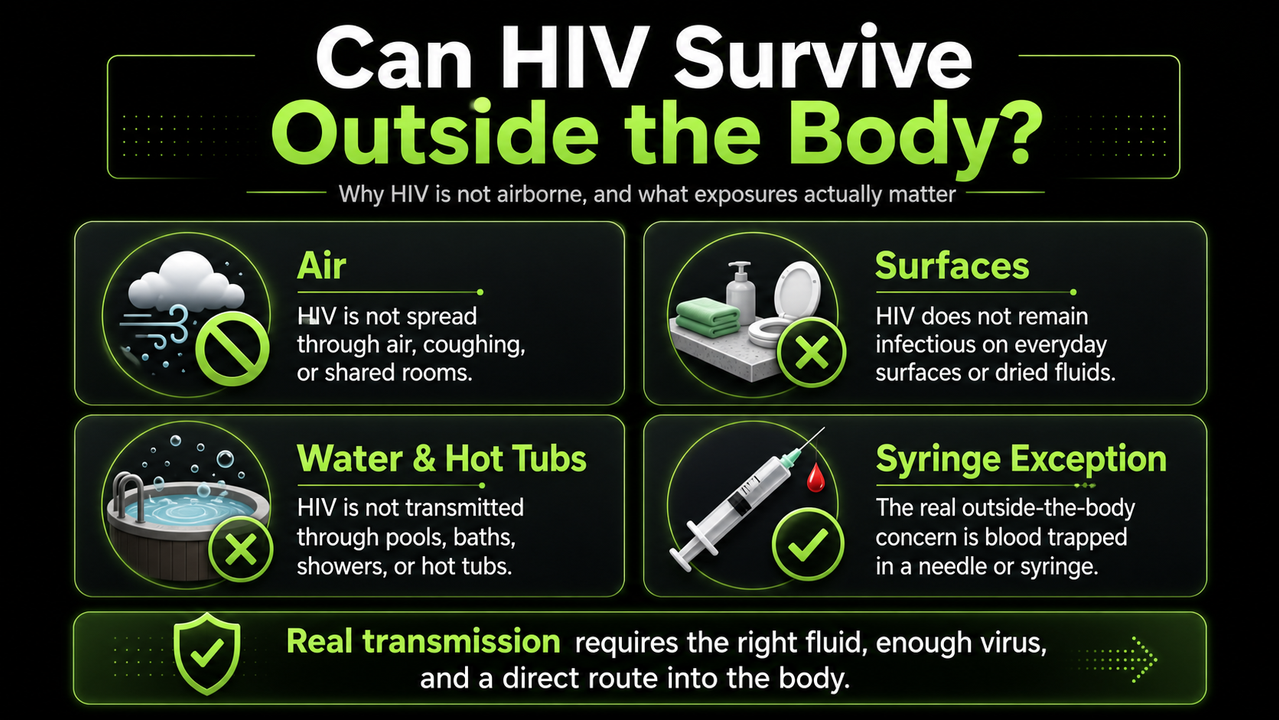
HIV is not an environmental transmission virus. Air, water, hot tubs, toilets, towels, and ordinary surfaces do not provide the right route for infection.
Ways HIV is not transmitted
Most environmental HIV fears fail the basic transmission requirements. The situations below are not realistic HIV transmission routes.
| Situation | HIV risk? | Why |
|---|---|---|
| Breathing the same air | No risk | HIV is not airborne and does not spread through coughing, sneezing, or sharing a room. |
| Hot tubs, pools, baths, showers | No risk | HIV is not transmitted through water. Dilution, heat, chemicals, soap, and environmental exposure make this route unrealistic. |
| Toilet seats, towels, bedding, clothes | No risk | HIV does not spread through casual surface contact or shared household items. |
| Dried blood on a surface | Generally no realistic risk | HIV does not survive well outside the body and becomes damaged as fluids dry. |
| Sweat, tears, saliva | No risk unless visibly mixed with significant fresh blood | These fluids are not effective HIV transmission routes. |
| Discarded needle injury | Very low, but seek medical advice | A needle can bypass the skin barrier, so it is assessed differently from casual surfaces. |
What HIV needs to infect a person
HIV transmission is not just “contact.” It is a chain of requirements. If any link breaks, transmission does not occur.
The right body fluid
The main infectious fluids are blood, semen, vaginal fluids, rectal fluids, and breast milk. HIV is not transmitted through sweat, tears, casual saliva contact, or ordinary environmental moisture.
Enough viable virus
Transmission requires a sufficient amount of infectious virus. Detecting viral material in a lab is not the same as finding intact virus capable of causing infection in real life.
A direct route inside
HIV must reach susceptible cells through a real entry pathway, usually through mucous membranes, direct blood exposure, or a puncture. Intact skin is a strong barrier.
Air, surfaces, water, towels, toilets, and hot tubs fail the transmission requirements. They do not provide the right protected environment, the right route, or a realistic dose of viable virus.
Can HIV spread through air?
No. HIV is not airborne. It does not spread through breathing, coughing, sneezing, sharing a room, sitting near someone, or being in the same indoor space.
Airborne viruses are built to survive and travel in respiratory droplets or aerosols. HIV is not that kind of virus. It is transmitted through specific body fluids under specific conditions, not through the air.
Drying damages the virus
HIV is an enveloped virus, meaning it has a fragile outer lipid membrane. When exposed to air and drying, the structures HIV needs to infect cells are disrupted.
It cannot reproduce outside the body
HIV needs living human cells to replicate. It does not multiply on surfaces, in air, in water, on clothes, or on household objects.
HIV does not “live in the air.” Sharing air with someone who has HIV carries no HIV transmission risk.
Can HIV survive on surfaces?
HIV does not survive well outside the human body. Environmental exposure, drying, temperature changes, cleaning products, and time all reduce the virus’s ability to remain infectious.
This is why HIV is not transmitted by touching doorknobs, phones, gym equipment, tables, bedding, towels, clothing, toilet seats, or bathroom surfaces.
Toilet seats
Toilet seats are not an HIV transmission route. Intact skin is a barrier, and HIV is not transmitted through casual contact with bathroom surfaces.
Towels and bedding
HIV is not spread through towels, bedding, laundry, clothes, or fabric. Drying and environmental exposure make this route unrealistic.
Gym or public surfaces
Touching shared equipment or public surfaces does not transmit HIV. Ordinary hygiene is enough for general cleanliness.
If the event was touching a surface, sitting somewhere, using a toilet, handling clothes, touching a towel, or cleaning an object, HIV is not the realistic concern.
Can you get HIV from dried blood?
Dried blood is one of the most common HIV anxiety triggers. In everyday environments, casual contact with dried blood on a surface is not considered a realistic HIV transmission route.
The reason is simple: HIV rapidly loses infectivity as blood dries and is exposed to air. Intact skin also blocks entry. For transmission to become a concern, there would need to be a meaningful amount of fresh infectious blood and a direct route into your bloodstream or vulnerable tissue.
Touching dried blood with intact skin is not a realistic HIV transmission route. A fresh blood-to-blood puncture injury is a different scenario and should be assessed medically.
Can you get HIV from a hot tub, pool, bath, or shared water?
No. HIV is not transmitted through water. You cannot get HIV from sitting in a hot tub, swimming pool, bath, shower, steam room, sauna area, or shared water with someone who has HIV.
For HIV transmission to happen, enough infectious fluid has to get directly into the bloodstream or vulnerable mucous membranes. Diluted water, heat, chemicals, chlorine, soap, and environmental exposure all make this route biologically unrealistic.
Even if there were tiny traces of blood, semen, or vaginal fluid in water, HIV would be diluted and damaged outside the body. That is not how HIV transmission occurs.
Hot tubs and pools
Hot tub or pool water does not transmit HIV. Heat, dilution, chlorine, and environmental exposure break the chain needed for infection.
Baths and showers
Shared water, bath water, shower water, and bathroom moisture are not HIV transmission routes.
Hot tubs do not transmit HIV. The realistic risks in hot tubs are not HIV from the water. They are things like skin irritation, bacterial exposure, or sexual contact that happens separately from the water itself.
Can you get HIV from toilets, towels, bedding, or clothes?
No. HIV does not spread through toilet seats, toilet water, towels, bedding, sheets, clothing, underwear, laundry, or shared household items.
These are classic HIV myths. They involve surfaces, fabrics, drying, dilution, and intact skin rather than a direct route into the bloodstream or vulnerable mucous membranes.
Sharing a home, bathroom, bedding, clothes, towels, or laundry with someone who has HIV does not put you at risk.
What about saliva, sweat, tears, spit, or shared drinks?
HIV is not transmitted through sweat, tears, or casual saliva contact. Sharing food, drinks, utensils, cups, or casual kisses is not an HIV transmission route.
Spitting is also not a documented route of HIV transmission. The only time saliva becomes medically different is if it is visibly mixed with a significant amount of fresh blood and that blood has a direct route into another person’s bloodstream or vulnerable tissue.
Sweat
HIV is not spread through sweat, including gym sweat or skin contact.
Tears
HIV is not spread through tears or casual facial contact.
Saliva
HIV is not spread through saliva, shared drinks, shared utensils, or ordinary spitting.
What about discarded needles?
A discarded needle is different from air, surfaces, toilet seats, towels, or water because a needle can puncture the skin and bypass the normal surface barrier.
Even so, HIV risk from community discarded needle injuries is generally considered very low. The more important point is that a needle injury deserves medical assessment because clinicians may consider HIV, hepatitis B, hepatitis C, tetanus, wound care, PEP timing, and follow-up testing.
They can bypass skin
Surfaces require an entry route. A needle can create one. That is why needle-stick injuries are handled differently from touching dried fluid.
Wash and seek advice
Wash the area with soap and water and seek medical advice promptly. A clinician can decide whether PEP or follow-up testing is needed.
Do not treat a needle-stick injury like casual surface contact. HIV risk may still be low, but it is worth clinical guidance because the exposure route is different.
When HIV transmission actually can happen
HIV transmission happens through specific routes, not through general environmental exposure. The main routes are:
Anal or vaginal sex
Condomless anal or vaginal sex with a partner who has transmissible HIV is one of the main sexual routes. Risk changes dramatically with condoms, PrEP, and undetectable viral load.
Shared injecting equipment
Sharing needles or syringes can transmit HIV because blood can be injected directly into the bloodstream.
Pregnancy, birth, breastfeeding
HIV can be transmitted from parent to child without treatment, but modern care and viral suppression reduce this risk dramatically.
Rare healthcare exposures
In modern regulated healthcare settings, transmission through blood products or medical equipment is extremely rare because of screening and infection control.
If your concern was air, water, a hot tub, dried surfaces, towels, toilet seats, sweat, or saliva, you are not describing a realistic HIV transmission route. If your concern involved condomless anal or vaginal sex, shared injecting equipment, or a needle-stick injury, that is a different category.
If your concern involved a real exposure route and you want a personalised estimate based on your exact encounter and location, the assessment below calculates a probability and gives a testing timeline with exact dates.
Frequently asked questions
Is HIV airborne?
No. HIV is not airborne and cannot spread through breathing, coughing, sneezing, or sharing the same room.
Can HIV spread through water?
No. HIV is not transmitted through water, including hot tubs, swimming pools, baths, showers, steam rooms, or shared water.
Can HIV survive on surfaces?
HIV does not survive well outside the body and cannot reproduce outside a human host. Casual contact with surfaces is not an HIV transmission route.
Can you get HIV from dried blood?
HIV becomes damaged as blood dries and is exposed to the environment. Casual contact with dried blood on a surface is not a realistic transmission route. Fresh blood entering a puncture wound or needle injury should be assessed differently.
Can you get HIV from a hot tub?
No. HIV is not transmitted through hot tub water. Heat, dilution, chemicals, and exposure outside the body make this route unrealistic.
Can I get HIV from a toilet seat, bedding, towels, or laundry?
No. These are classic HIV myths. Environmental surfaces and fabrics are not HIV transmission routes.
What about saliva, spitting, or sharing drinks?
HIV is not transmitted through saliva, and spitting is not a documented route of HIV transmission. Sharing drinks, utensils, or food is not a route.
Can HIV enter through small cuts on my hands?
A common anxiety scenario is dried fluid on a surface plus a tiny cut. That chain is not a recognised real-world route. A fresh blood-to-blood puncture injury is different and is worth clinical guidance.
What should I do after a discarded needle injury?
Wash the area with soap and water and seek medical advice promptly. The HIV risk is generally low, but a clinician can assess whether PEP, hepatitis testing, vaccination, or follow-up blood tests are needed.
If I am within 72 hours of a higher-risk exposure, what should I do?
PEP is time-sensitive and is generally considered only within 72 hours after a potential HIV exposure. If you are inside that window and genuinely concerned, contact urgent care or a sexual health clinic promptly.
Sources & References
- CDC, “How HIV Spreads”: cdc.gov/hiv/causes
- NIH HIVinfo, “Understanding HIV Transmission”: hivinfo.nih.gov transmission fact sheet
- HIV.gov, “How is HIV Transmitted?”: hiv.gov transmission overview
- NHS, “HIV and AIDS”: nhs.uk HIV and AIDS
- Abdala N. et al. (2000). “Survival of HIV-1 in syringes: effects of temperature...”: pubmed.ncbi.nlm.nih.gov/10921429
This article is for education, not diagnosis or personal medical advice. If you believe you had a higher-risk exposure, or you are within a time window where PEP may apply, contact a clinician or sexual health service.